Prioritize access
Useful around side walls, narrow bays, and garages where doors or equipment divide the ceiling into smaller usable zones.
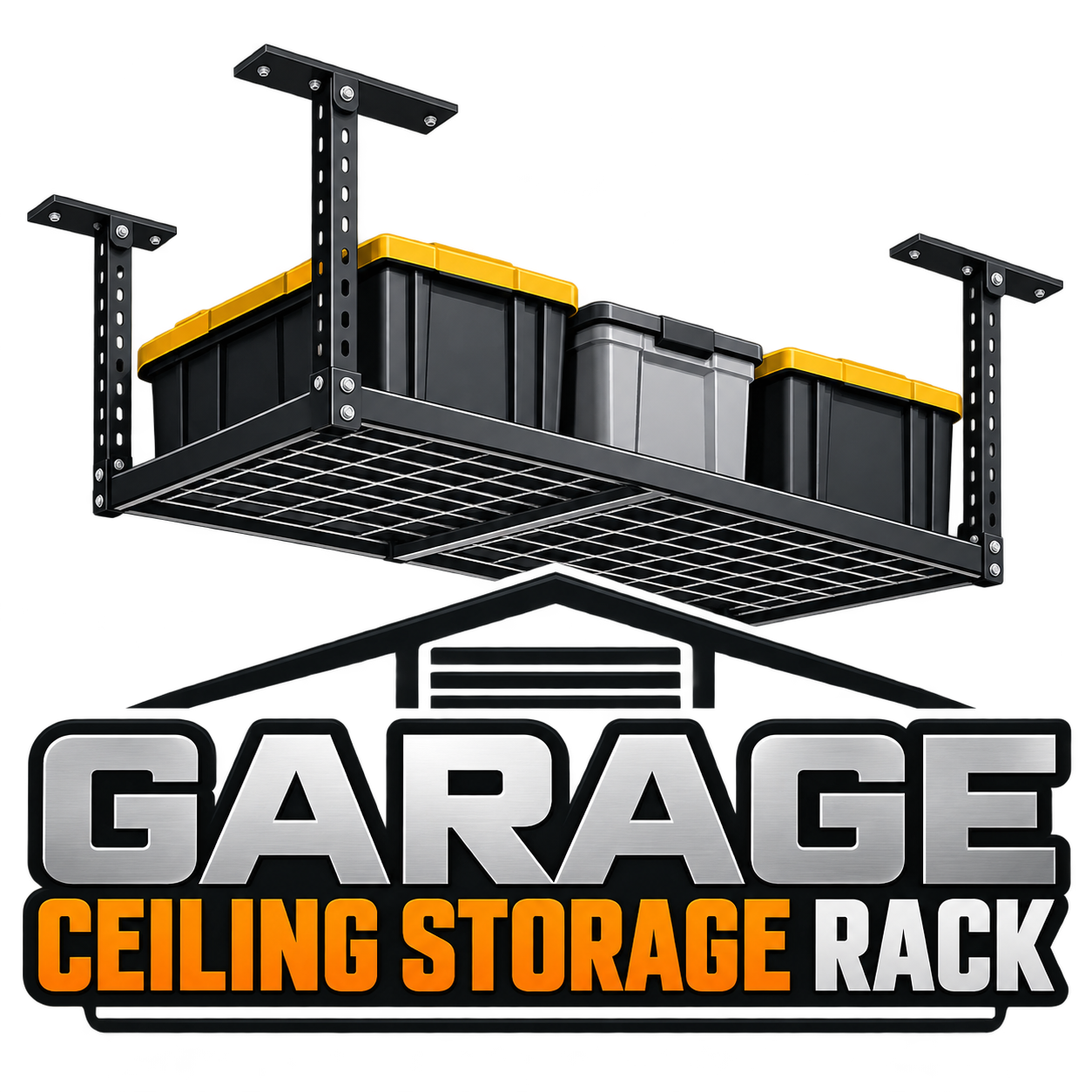
GARAGE CEILING STORAGE PLANNING
The best overhead rack is not simply the one with the biggest platform or the highest advertised capacity. It is the rack that fits your ceiling structure, clears the garage door and opener, leaves usable headroom, and gives you enough storage without turning installation into a compromise.
A practical buying framework
Ceiling-mounted storage can free a surprising amount of floor and wall space, but overhead storage is less forgiving than a freestanding shelf. The rack has to work with the structure above the drywall, the moving envelope of the garage door, the height of the vehicle below, and the way you actually load and retrieve bins.
That is why this guide treats a garage ceiling storage rack as a small system rather than a single product. First define the space and structural constraints. Then compare rack size, drop range, installation method, and manufacturer-rated load. Only after those decisions should features such as accessory hooks, color, deck style, or modular expansion break a tie.
Decision 1
A larger platform is useful only when the full footprint can sit in a clear ceiling zone. Measure the usable rectangle between tracks, lights, attic openings, cabinets, wall obstructions, and the garage-door travel area before deciding that a 4×8 rack is automatically better than a narrower or shorter rack.
Think of rack size in two dimensions. Width determines how much ceiling territory the rack consumes, while depth determines how far it projects into the garage. In a two-car garage, one large platform can create efficient bulk storage. In a narrow bay, a compact rack may preserve better access and leave room for ladders, bikes, doors, or another storage system.
If the garage has awkward zones, split the storage plan. A compact rack over a side aisle can be more usable than forcing one oversized platform into the center. Our guide to compact overhead garage storage racks for small spaces explains when smaller footprints make more sense.
Useful around side walls, narrow bays, and garages where doors or equipment divide the ceiling into smaller usable zones.
Good for matching rows of bins when the joist layout and clear ceiling footprint support a longer platform.
Best considered only after verifying door travel, opener clearance, lighting, and convenient access from below.
Decision 2
A ceiling rack is only as useful as its attachment plan. Before shopping by capacity, identify the framing direction, locate the structural members the manufacturer expects you to use, and confirm that the rack’s mounting pattern can be positioned where you need it. Drywall is a finish layer, not a substitute for the structural attachment described in the rack instructions.
Joist direction matters because it controls where ceiling brackets can land. Some garages make a centered rack easy; others force the rack several inches to one side or make a different footprint more practical. Finished ceilings also make accurate layout more important because the structure is hidden.
Do not transfer the mounting instructions from one rack to another. Fastener size, required penetration, framing assumptions, bracket spacing, and allowable configurations can differ by manufacturer and model. Use the manual for the exact rack you buy, especially for engineered trusses, unusual framing, concrete, steel structures, or ceilings with utilities nearby.
Decision 3
The clearance calculation should use the highest moving point of the door and hardware, not the door position when it is closed. Also account for opener rails, motors, lighting, torsion hardware, tracks, and anything else that occupies the ceiling zone. A rack that looks clear in a still photo can interfere with the door during travel.
If you want storage above the door, measure with the door operating through its complete path. Then compare that available vertical space with the rack’s minimum drop and the height of the bins you expect to store. Our above-garage-door overhead storage planning guide walks through that scenario in more detail.
Vehicle clearance deserves a separate check. SUVs, roof rails, cargo boxes, antennas, open hatches, and lifted vehicles can reduce the space you thought you had. Use the garage ceiling rack clearance for an SUV guide when the rack will sit over a parking position.
Decision 4
Adjustable drop range is one of the most important specifications because it determines the space between the ceiling and the rack deck. A deeper drop can hold taller bins, but it also lowers the bottom of the rack. A shallow drop preserves headroom and vehicle clearance but may restrict what you can place on the platform.
Choose drop height from the objects you plan to store, not from the maximum adjustment shown on the product page. Measure your common bins, add practical loading clearance, and make sure you can still lift them onto the rack safely. If the garage has a low ceiling, our overhead garage storage for low ceilings guide provides a more conservative planning approach.
For adjustable models, check whether the available positions fit your desired height rather than assuming infinitely variable adjustment. The separate garage ceiling rack drop range guide explains how to turn manufacturer dimensions into a usable installation plan.
Decision 5
A published rack load rating is meaningful only within the installation conditions defined by that manufacturer. The rack, fasteners, attachment points, ceiling framing, load distribution, and installation quality work together. A large capacity number should never be used to justify loading questionable framing or exceeding another part of the system.
Plan the stored load before installation. Seasonal decorations, camping equipment, empty roof boxes, and lightweight plastic bins create a different use case from dense tools, liquids, batteries, or heavy automotive parts. Keep frequently used and very heavy objects in locations that are easier to reach unless the rack and installation are specifically suited to them.
Read our garage ceiling rack load rating guide for a fuller explanation of capacity, distribution, and why the rated number should be treated as an upper boundary rather than a storage target.
What belongs overhead?
Ceiling storage works best for bulky, dry, relatively infrequent-use items: holiday decorations, camping gear, sports equipment, spare household supplies, coolers, luggage, and labeled seasonal bins. The goal is to reclaim floor area without making every retrieval difficult.
Items used every week usually belong at eye or waist height. Very heavy items, fragile valuables, hazardous materials, or anything that can leak should be evaluated more carefully before going overhead. Access matters too: if every bin requires an awkward ladder position, the rack may be technically large enough but practically inconvenient.
Fixed rack or powered lift?
A fixed overhead rack is mechanically simple and makes sense when you are comfortable using a suitable ladder and the stored items are not moved often. A motorized ceiling lift changes the access model by bringing the platform down, but it adds cost, electrical or mechanical components, operating clearances, and another set of installation requirements.
If frequent access is more important than maximum simplicity, compare the tradeoffs in our guide to planning a motorized garage ceiling storage lift. Do not treat a powered lift as a universal replacement for fixed racks; the right choice depends on the garage, the load, and how often you need the stored items.
Accessories
Hooks, straps, utility hangers, bike attachments, and accessory bars can make good use of the rack perimeter, but they should support a storage plan rather than compensate for a rack that does not fit. First solve footprint, structure, clearance, drop, and load. Then decide whether accessories improve how the system works.
Our garage ceiling rack accessories planning guide covers accessory choices and the questions to ask before hanging additional equipment from an overhead system.
Buying checklist
| Compare | Why it matters | What to verify |
|---|---|---|
| Footprint | Controls usable storage area and ceiling fit | Clear rectangle, lights, attic access, tracks and cabinets |
| Mounting pattern | Determines whether brackets can reach suitable framing | Joist direction, spacing and manufacturer instructions |
| Drop range | Controls bin height and clearance below | Actual adjustment positions, not just maximum range |
| Load rating | Defines the manufacturer’s system limit | Installation conditions and even-load requirements |
| Deck design | Affects support, visibility and small-item handling | Wire spacing, panel layout and edge retention |
| Access | Determines whether storage remains convenient | Ladder position, vehicle location and retrieval frequency |
| Accessories | Can expand perimeter storage | Compatibility and any effect on load limits |
Frequently asked questions
No. A 4×8 platform offers a large storage area, but the better size is the one that fits the clear ceiling footprint, structural layout, door travel, vehicle clearance, and access needs of your garage.
No. Ceiling-mounted racks require attachment according to the manufacturer’s structural installation instructions. The visible drywall does not tell you by itself whether a location is suitable.
Sometimes. You need enough clearance above the highest point of the moving door and its hardware, plus the rack drop and stored-item height. Measure the complete operating path before choosing the location.
Stay within the limit and installation conditions published for the exact model, and account for the framing and attachment requirements in its manual. The advertised capacity is a limit, not a target.
Bulky, dry, seasonal and infrequently used items are usually the best candidates. Keep access frequency, lifting effort, leakage risk and total load in mind.
The short version
Start with the ceiling footprint and framing. Map the garage door and opener travel. Decide how much drop you can afford. Estimate the real items and load you want overhead. Then compare racks that fit those constraints. That sequence turns product shopping into a much simpler decision and reduces the chance that a rack arrives with the wrong footprint, drop range, or installation assumptions.
Our product recommendations are selected around the planning criteria on this page. Product specifications and installation requirements can change, so verify the current manufacturer documentation before purchase and installation.